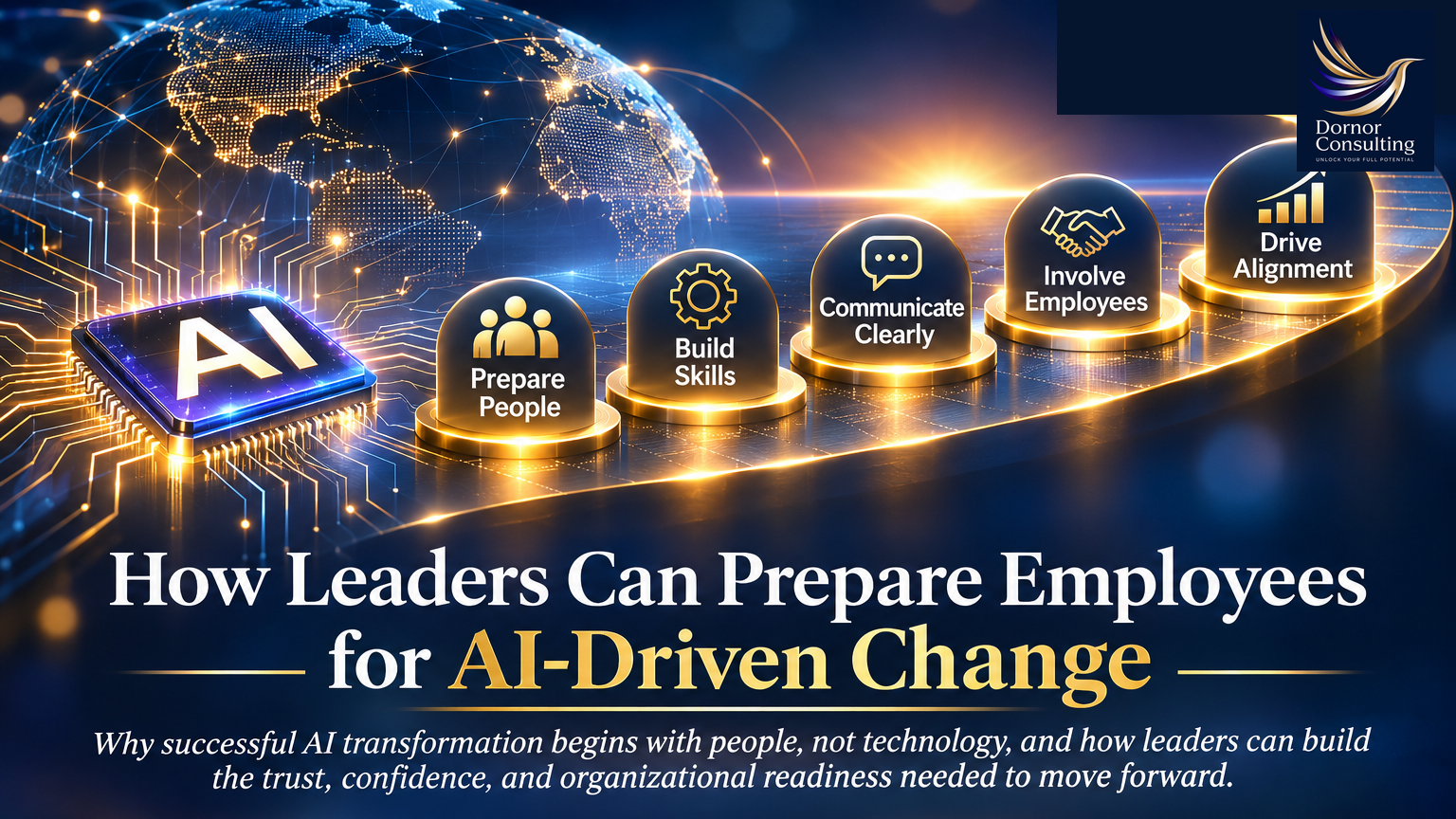
How Leaders Can Prepare Employees for AI-Driven Change
Why successful AI transformation begins with people, not technology, and how leaders can build the trust, confidence, and organizational readiness needed to move forward.
The technology may be ready. But are your people?
Artificial intelligence is changing how organizations operate, how decisions are made, and how employees perform their work. From automating administrative processes to supporting strategic analysis, AI is creating opportunities for greater efficiency, innovation, and organizational growth.
Yet there is a question that deserves just as much attention as the technology itself. Are employees prepared for the changes that AI will bring to their daily work?
An organization can invest in advanced technology, hire technical experts, and develop an ambitious implementation strategy. However, none of those investments automatically produces employee confidence, trust, or readiness.
Leaders must prepare employees for AI-driven change by communicating its purpose, addressing legitimate concerns, developing practical capabilities, involving employees in implementation, and creating an environment where learning and adaptation are supported.
The challenge is not simply introducing a new tool. It is helping people navigate a new way of working. And those are two very different leadership responsibilities.
1. Understand why employees may resist AI adoption
Imagine an organization introducing an AI platform designed to improve productivity. The executive team is excited. The technology department has completed its evaluations. Leadership anticipates faster workflows and improved operational performance.
Meanwhile, employees are asking different questions. Will this technology replace my position? Will I be expected to accomplish more work in less time? What happens if I make a mistake while using AI? Will my experience and professional judgment still matter?
These questions are not necessarily evidence of resistance to innovation. They may reflect uncertainty about job security, professional identity, performance expectations, and the future of work.
Consider a hypothetical employee named Avery, who has spent fifteen years developing expertise in a particular field. When leadership introduces AI, Avery may recognize its potential while simultaneously wondering whether years of accumulated knowledge are becoming less valuable.
Avery does not necessarily need another presentation about the benefits of artificial intelligence. Avery needs leadership to explain how professional expertise will remain relevant, what will change, and what support will be available.
When organizations interpret every concern as unwillingness to change, they risk overlooking valuable information about their employees’ actual readiness. Effective leaders distinguish between resistance, reasonable skepticism, inadequate training, and genuine implementation problems.
2. Communicate the purpose before introducing the technology
One of the most consequential mistakes leaders can make is announcing an AI initiative without explaining the organizational reasoning behind it. Employees may hear that a new platform is being implemented, but they may not understand the problem it is intended to solve.
Leadership communication should explain why the organization is adopting this technology, which workflows may change, what remains under human oversight, and how employees will be supported throughout the transition.
Transparency does not require leaders to have every answer. It requires them to distinguish between what has been decided, what is still being evaluated, and what employees can influence.
For example, rather than promising that AI will never affect staffing, a leader can explain the current workforce plan, acknowledge uncertainty, and commit to communicating material changes as decisions are made.
Employees are more likely to participate meaningfully when communication respects their intelligence rather than simply attempting to generate enthusiasm.
3. Recognize the difference between technical training and human readiness
Organizations frequently approach AI implementation as a training problem. They purchase software, schedule demonstrations, distribute instructions, and assume employees will begin using the technology.
But knowing which buttons to press is not the same as feeling prepared to work differently. Technical proficiency is important. Human readiness is broader.
Employees may need support in evaluating AI-generated information, exercising professional judgment, managing uncertainty, understanding appropriate data use, and adapting familiar workflows.
Consider two employees who complete the same AI training. One immediately begins experimenting with the platform. The other understands the instructions but hesitates to use the tool on an actual assignment.
The difference may not be intelligence, motivation, or technical ability. It may involve confidence, perceived risk, previous experiences with organizational change, or the consequences employees expect if something goes wrong.
Leaders must therefore examine not only whether employees have completed training, but whether they can apply what they learned appropriately and confidently.
4. Build psychological safety without abandoning accountability
AI adoption requires experimentation, and experimentation introduces the possibility of mistakes. Employees who fear embarrassment or punishment may avoid asking questions, identifying problems, or acknowledging that they do not understand a new system.
This creates a serious challenge for organizations introducing technology that can generate inaccurate, incomplete, or misleading information.
Psychological safety does not mean eliminating performance expectations. It means creating conditions where employees can raise concerns, seek clarification, and report errors without unnecessary interpersonal risk.
Leaders can reinforce this environment by openly discussing AI limitations, inviting constructive feedback, establishing clear escalation procedures, and recognizing employees who identify potential risks.
At the same time, organizations must maintain appropriate controls for confidentiality, cybersecurity, regulatory obligations, and human review.
A culture of responsible experimentation requires both trust and boundaries. Employees should understand where experimentation is encouraged and where independent verification or formal approval is mandatory.
5. Involve employees in designing the change
Employees often understand operational realities that are less visible to senior leadership. They know which processes create unnecessary work, where customers experience frustration, and which tasks require professional judgment that may be difficult to automate.
This knowledge is essential to responsible AI adoption. Rather than designing every workflow from the executive level, leaders can involve employees in identifying suitable use cases, testing tools, evaluating outcomes, and refining implementation plans.
For example, a customer service organization might invite experienced representatives to evaluate whether AI-generated responses are accurate, respectful, and appropriate for complex customer situations.
The representatives may identify important nuances that were not apparent during the initial technology evaluation. Their involvement can improve implementation quality while reinforcing that employee expertise remains valuable.
Participation does not mean every employee makes every decision. It means decisions benefit from the knowledge of people who will be directly affected.
6. Measure readiness, not merely technology usage
Many organizations evaluate AI initiatives through indicators such as software licenses activated, training sessions completed, or frequency of platform use. Those measures can be useful, but they provide an incomplete picture.
An employee may use an AI tool frequently without understanding its limitations. Another may use it selectively because certain tasks require greater human judgment. Neither pattern automatically establishes success or failure.
Leaders should examine whether employees understand appropriate use, demonstrate relevant capabilities, trust the reporting process, and can identify when AI output requires correction.
Useful questions include: Can employees explain when AI should and should not be used? Do they know how to protect confidential information? Can they recognize potentially inaccurate outputs? Are they comfortable raising concerns? Has the technology improved work quality or merely increased activity?
The goal is not to maximize AI usage at any cost. It is to achieve responsible, measurable improvements in how work gets done.
7. Prepare managers to lead the transition
Senior executives may establish the strategic direction, but frontline and middle managers often determine how change is experienced.
Managers translate organizational priorities into daily expectations. They answer employee questions, identify capability gaps, monitor workload, and address problems that arise during implementation.
If managers are unprepared, even a carefully designed AI strategy can become inconsistent across departments.
Organizations should equip managers with practical guidance about approved AI uses, escalation procedures, employee development, workload expectations, and how to discuss uncertainty.
Managers also need opportunities to develop their own AI literacy. A manager who does not understand a tool’s capabilities or limitations may struggle to evaluate employee performance fairly.
Leadership readiness must therefore extend throughout the organization, not remain concentrated within the executive team or technology department.
From awareness to meaningful organizational alignment
A useful way to examine AI-driven change is to consider three connected organizational conditions: awareness, capacity, and alignment.
Awareness concerns whether employees and leaders understand what is changing and why. Capacity concerns whether people have the skills, resources, support, and practical ability to respond. Alignment concerns whether organizational expectations, leadership behavior, workflows, and employee capabilities support the same intended outcomes.
These ideas are consistent with the sequence of the Becoming Alignment Triangle™ used within Dornor Consulting’s transformation work.
Consider an organization where employees understand the benefits of AI but have insufficient time to learn the new technology. Awareness may be present, but capacity is constrained.
Now imagine employees receive excellent training, yet their performance evaluations continue rewarding the old workflow. Capacity may be improving, but organizational alignment is missing.
This is why implementation cannot be treated as a single training event. Successful change requires leaders to examine the conditions surrounding employee behavior, not merely the behavior itself.
What leaders can do in the next 30 days
Organizations do not need to resolve every AI challenge before beginning to strengthen readiness. A practical starting point is a focused 30-day leadership review.
During the first week, leaders can identify the specific business problem AI is expected to address and clarify which decisions remain under human authority.
During the second week, they can invite employees and managers to identify concerns, workflow opportunities, training needs, and foreseeable risks.
During the third week, they can select one appropriate, limited use case and establish expectations for training, oversight, and evaluation.
During the fourth week, they can review what employees experienced, what the technology actually improved, and what should change before expanding adoption.
This approach does not guarantee successful implementation. It creates a more informed basis for making decisions. Most importantly, it gives leaders an opportunity to listen before assuming that their implementation strategy reflects the realities of the workforce.
The future of AI transformation is also a leadership decision
Artificial intelligence will continue to influence how organizations compete, innovate, and deliver value. But technology alone does not determine whether an organization becomes more capable, resilient, or effective.
Leadership decisions matter. The way leaders communicate, allocate resources, respond to concerns, establish safeguards, and develop their employees shapes how technology is adopted.
Employees are not simply the recipients of organizational change. They are participants whose expertise, judgment, and adaptability influence whether that change produces meaningful results.
The most important question for leaders may not be how quickly their organization can introduce AI. It may be whether they are building an organization capable of using it wisely.
Because preparing employees for AI-driven change is ultimately about preparing people for a future in which technology evolves, responsibilities shift, and human judgment remains essential.
And that kind of transformation requires more than innovation. It requires intentional leadership.
Prepare your organization for human-centered AI change
Successful AI adoption requires more than new technology. Explore how Dornor Consulting LLC can help your organization address leadership readiness, workforce capability, and the human dimensions of transformation.
Share your organization’s priorities through the existing Corporate Inquiry form.