
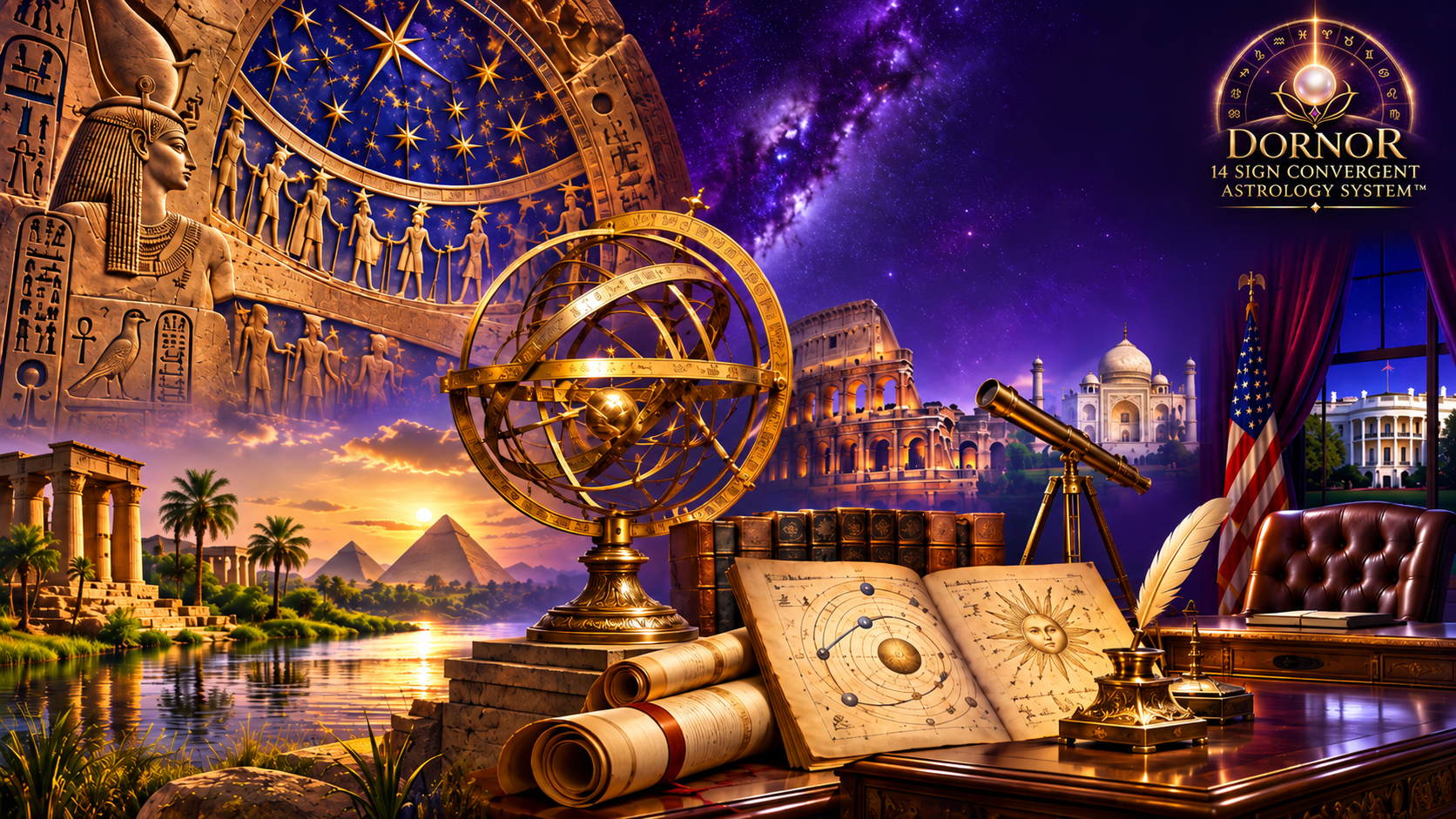
The Hidden History of Astrology and Power: How Rulers, Presidents, and Financial Elites Consulted the Stars
From ancient imperial courts to the Reagan White House, discover astrology’s documented role in political strategy, financial speculation, and the pursuit of power.
The History We Rarely Discuss
When most people hear the word astrology, they think of zodiac signs, personality descriptions, relationship compatibility, or daily horoscopes.
But astrology has a much longer and more politically significant history.
For thousands of years, celestial interpretation has occupied a place in the decision-making environments of emperors, monarchs, political advisers, military strategists, and wealthy financiers.
This is not merely a collection of mysterious stories circulating through spiritual communities. Surviving court documents, historical manuscripts, personal memoirs, and institutional archives establish that astrological consultation was part of the political and intellectual culture of numerous civilizations.
That raises an interesting question.
Why would individuals who possessed extraordinary wealth, political authority, and access to sophisticated advisers also seek guidance from astrologers?
The answer requires us to examine astrology not simply as a spiritual practice, but as a historical institution connected to knowledge, uncertainty, legitimacy, and power.
There is also an important distinction we must preserve throughout this discussion. Historical evidence that someone consulted an astrologer does not automatically establish that astrology determined their decisions, that the predictions were accurate, or that the practice possesses scientifically demonstrated predictive power.
Nevertheless, the documented history deserves serious examination.
1. Before Astrology Became Personal, It Was Political
Ancient Egypt, Kemet, and the Nile Valley: Celestial Knowledge as a Foundation for Civilization
Before examining Babylonian and Assyrian traditions, we must recognize the extraordinary astronomical knowledge developed in ancient Egypt, known as Kemet, a Nile Valley civilization.
The ancient Egyptians developed sophisticated astronomical knowledge long before the later Babylonian and Assyrian traditions. Their observations of celestial movements were deeply connected to agriculture, timekeeping, spiritual practices, and the organization of daily life.
For the ancient Kemetic civilization, observing the heavens was deeply connected to organizing life on Earth.
One of the most significant examples involved the star Sirius, known in ancient Egypt as Sopdet and later by the Greek name Sothis.
Its annual heliacal rising, when the star first became visible in the eastern sky shortly before sunrise after a period of invisibility, occurred around the time of the Nile’s annual inundation.
The people of Kemet recognized this celestial pattern and incorporated it into their understanding of seasonal change, agricultural preparation, religious observances, and the organization of the year.
The annual flooding of the Nile was essential to agricultural life. Floodwaters replenished the surrounding land with fertile sediment, supporting the cultivation of crops that sustained the civilization.
Recognizing seasonal patterns helped communities anticipate the changing conditions necessary for agriculture.
The Kemetic agricultural calendar recognized three principal seasons:
- Akhet, the season of inundation, when the Nile flooded its surrounding lands.
- Peret, the season of emergence and cultivation, when floodwaters receded and agricultural land became available for planting.
- Shemu, the season associated with harvesting and the return of drier conditions.
Astronomical observation was therefore inseparable from practical questions concerning food production, water management, timekeeping, and community organization.
The ancient Egyptians also developed sophisticated calendrical systems, including a civil calendar of 365 days, and used stellar observations to measure time during the night.
Their system of decans, groups of stars associated with intervals of the year and night, demonstrates the complexity of their celestial knowledge.
Importantly, the relationship between Sirius and the Nile was an observed seasonal correlation, not evidence that the star physically caused the flooding. The inundation resulted from seasonal rainfall upstream, particularly in the Ethiopian highlands.
This distinction does not diminish Kemetic astronomical achievement. It demonstrates the remarkable ability of ancient observers to recognize and use recurring celestial and environmental patterns.
Their astronomical practices also operated within a broader spiritual and cosmological understanding of existence.
Celestial observation, divine symbolism, agricultural cycles, and the organization of human life were deeply interconnected.
When examining the history of astrology and power, we must therefore acknowledge ancient Egypt, Kemet, and the Nile Valley as a major civilization whose astronomical knowledge served practical, institutional, and sacred purposes.
Its contributions belong within the historical record, not outside it.
Celestial Interpretation in Mesopotamia
Long before astrology became associated with individual birth charts, celestial observations were also incorporated into the affairs of ancient states.
In Mesopotamia, particularly within Babylonian and Assyrian traditions, scholars observed eclipses, planetary movements, and other celestial phenomena for their possible significance to kings and kingdoms.
Collections such as Enūma Anu Enlil preserved celestial omens interpreted in relation to political events, agricultural conditions, military affairs, and royal security.
This was not the modern practice of asking whether two zodiac signs were romantically compatible.
It was a system through which specialists attempted to interpret uncertainty affecting entire societies.
Royal authorities could receive celestial reports alongside other forms of intelligence and counsel. The sky became one of several sources through which political risks were understood.
The distinction matters because astrology’s historical relationship with power did not begin as an individual lifestyle preference.
In some of its earliest documented institutional forms, it was directly connected to the interests of rulers.
2. The Roman Emperor Who Trusted an Astrologer
The Roman emperor Tiberius, who ruled from 14 to 37 CE, maintained a relationship with Thrasyllus of Mendes, a scholar and astrologer associated with his imperial circle.
Ancient accounts and modern classical scholarship describe Thrasyllus as a trusted adviser.
His presence illustrates how astrological expertise could become connected to political authority at the highest level.
Roman attitudes toward astrology were complicated. Astrologers could enjoy elite patronage while also facing restrictions or expulsion when their predictions threatened political stability.
Consider the contradiction.
A ruler might seek astrological guidance for personal security while viewing other people’s predictions about imperial succession as dangerous.
The issue was not simply whether astrology was believed.
It was also who possessed the authority to interpret the future and how that interpretation might influence political behavior.
Knowledge becomes politically significant when people believe it can affect decisions, loyalties, or expectations.
3. Queen Elizabeth I and the Astrologer John Dee
During the reign of Elizabeth I of England, astrology existed alongside mathematics, navigation, astronomy, medicine, and natural philosophy.
John Dee was a mathematician, scholar, astrologer, and adviser whose intellectual pursuits crossed boundaries that modern academic disciplines usually keep separate.
Historical accounts associate Dee with consultation concerning Elizabeth’s coronation timing. His broader work also involved navigation and England’s overseas ambitions.
It would be inaccurate to reduce Dee to a fortune-teller.
He represented a period when celestial mathematics, symbolic interpretation, and practical state interests could overlap.
For Elizabethan political culture, the relationship between celestial knowledge and government was not necessarily regarded as an unusual contradiction.
The historical question is not whether Dee’s astrological interpretations were scientifically valid.
It is why an educated royal court considered such expertise worthy of consultation.
4. When Astronomy and Astrology Shared an Imperial Office
The court of Rudolf II, Holy Roman Emperor, offers another revealing example.
Rudolf supported major intellectual figures, including Tycho Brahe and Johannes Kepler.
Today, Kepler is celebrated for his contributions to astronomy and the mathematical description of planetary motion.
Yet Kepler also practiced astrology.
Surviving historical materials include astrological interpretations associated with Rudolf, demonstrating that planetary calculations and political counsel could coexist within imperial scientific work.
This history challenges the simplified assumption that astronomy and astrology always occupied entirely separate intellectual worlds.
Their methods and purposes gradually diverged as scientific knowledge developed.
However, their earlier historical relationship was considerably more intertwined.
We must also avoid making the opposite mistake. Kepler’s scientific achievements do not validate astrology’s predictive claims.
The appropriate conclusion is historical: a major figure in the development of astronomy also participated in the astrological practices of his time.
5. Astrology in the Mughal Empire
Astrological consultation was not confined to Europe.
In Mughal India, imperial courts incorporated astronomical and astrological expertise from multiple intellectual traditions.
Emperors such as Humayun and Akbar operated within court environments where celestial calculations could inform ceremonial timing, royal horoscopes, and the selection of auspicious moments.
Scholarly research identifies Hindu and Muslim astronomer-astrologers working within Mughal institutions.
Different practitioners sometimes used different astronomical tables and interpretive methods, producing distinct calculations for the same royal subject.
That is especially interesting.
It demonstrates that historical rulers did not always rely upon one uniform astrological system.
Multiple traditions could coexist, compete, and be compared within the same political institution.
For contemporary students of astrology, this offers an important historical lesson: the world’s astrological traditions developed through different cultural, mathematical, philosophical, and religious contexts.
Their similarities deserve investigation, but their differences should not be erased.
6. The Astrologer Who Influenced the Reagan White House
One of the most extensively documented modern examples involves Nancy Reagan and astrologer Joan Quigley.
Following the attempted assassination of President Ronald Reagan on March 30, 1981, Nancy Reagan became increasingly concerned about her husband’s safety.
She consulted Quigley, a San Francisco astrologer who provided recommendations concerning favorable and unfavorable times for presidential activities.
The relationship became publicly controversial in 1988.
Former White House chief of staff Donald Regan described astrology’s influence on presidential scheduling, and Quigley later published her own account.
The Hoover Institution preserves Quigley’s archival papers, providing researchers with important material concerning her involvement.
According to the archival account, astrological recommendations influenced the timing of activities including presidential travel, debates, and diplomatic engagements.
However, the extent of Quigley’s influence remains disputed.
Nancy Reagan acknowledged consulting astrology while presenting its role more narrowly than some critics suggested. Ronald Reagan denied that astrology governed his substantive presidential decisions.
This distinction is essential.
There is substantial evidence of astrological influence on scheduling. That does not establish that astrology determined American foreign policy or presidential decisions.
Nevertheless, the case demonstrates that astrological consultation reached the operational environment of a modern American presidency.
And this was not ancient history.
It occurred during the late twentieth century.
7. J. P. Morgan, Wall Street, and the Famous Billionaires Claim
Perhaps one of the most frequently repeated stories in contemporary astrological communities concerns financier J. P. Morgan.
A popular saying attributed to Morgan suggests that millionaires do not use astrology, but billionaires do.
There is a problem.
The precise quotation has not been authenticated through reliable contemporary documentation.
That does not mean the history of financial astrology is imaginary.
Evangeline Adams, a prominent American astrologer during the late nineteenth and early twentieth centuries, developed a practice associated with wealthy clients and financial speculation.
Her autobiography, The Bowl of Heaven, includes claims of connections with prominent financiers, including Morgan.
However, historians have questioned whether independent documentary evidence sufficiently establishes the extent of Morgan’s personal involvement.
The famous quotation should therefore not be presented as a verified statement by Morgan.
What can be established is that financial astrology existed as a recognizable practice and that astrologers offered interpretations concerning economic cycles, market activity, and investment timing.
The distinction between documented historical practice and demonstrated financial effectiveness is critical.
The existence of financial astrology does not establish that planetary configurations reliably predict markets.
For modern investors, astrology should not replace financial analysis, risk management, or qualified professional advice.
Still, the historical relationship between financial speculation and celestial interpretation raises a fascinating question about how people respond to uncertainty when enormous sums of money are involved.
8. Astrology, Military Strategy, and Psychological Warfare
The relationship between astrology and power became especially unusual during World War II.
British intelligence employed astrologer Louis de Wohl in activities connected with wartime propaganda and psychological operations.
On the German side, Karl Ernst Krafft became involved in astrological and Nostradamus-related propaganda work associated with the Nazi apparatus.
These cases require careful interpretation.
The employment of astrologers in propaganda operations does not establish that Winston Churchill or Adolf Hitler personally directed military strategy through astrology.
Instead, it demonstrates something different.
Intelligence organizations recognized that beliefs about prophecy, destiny, and celestial signs could influence public perceptions and potentially be exploited during wartime.
In this context, astrology’s political importance was connected not necessarily to the accuracy of its predictions, but to the influence that people attributed to them.
That is a significant distinction in understanding the psychology of power.
A belief can influence behavior even when the underlying prediction has not been scientifically validated.
9. What Does This History Reveal About Power?
Across these civilizations and centuries, several recurring themes emerge.
First, leaders have often sought ways to reduce uncertainty.
Whether the concern involved succession, war, financial speculation, diplomatic travel, or personal safety, influential individuals faced decisions whose outcomes they could not completely control.
Second, knowledge and authority have always been intertwined.
An astrologer serving a royal court occupied a very different social position from someone offering informal advice in a village or marketplace.
Third, astrology historically served multiple purposes.
It could provide symbolic meaning, ceremonial timing, political reassurance, personal counsel, or a framework through which people interpreted complex events.
Fourth, the use of astrology did not guarantee agreement.
Different traditions, calculations, and interpretations could produce different conclusions.
And finally, the historical popularity of a practice should never be confused with scientific confirmation of its effectiveness.
These distinctions allow us to study astrology seriously without either dismissing its historical importance or exaggerating what the evidence proves.
10. How This History Connects to the Dornor 14 Sign Convergent Astrology System™
As the creator of the Dornor 14 Sign Convergent Astrology System™, I find this history particularly relevant because it reveals how different civilizations developed distinct approaches to interpreting celestial phenomena.
Recognizing the Astronomical Legacy of Kemet
An essential part of this historical examination is recognizing the contributions of ancient Egypt, Kemet, and the Nile Valley.
Long before modern distinctions between astronomy, astrology, and spiritual cosmology became established, the ancient Kemetic civilization integrated celestial observation into its understanding of time, agriculture, sacred practice, and human existence.
The observation of Sirius, the organization of the agricultural year around the Nile’s seasonal cycles, and the use of decans for timekeeping demonstrate that celestial knowledge had both practical and symbolic importance.
These achievements remind us that the intellectual history of astronomy and astrology cannot be accurately understood through a European or Mesopotamian lens alone.
African civilizations made substantial contributions to humanity’s understanding of the heavens.
For the Dornor 14 Sign Convergent Astrology System™, this history reinforces the importance of investigating multiple cultural and astronomical traditions without diminishing, overlooking, or erasing their origins.
A convergent approach requires more than comparing astronomical calculations. It also requires intellectual integrity concerning the civilizations whose observations, interpretations, and knowledge systems contributed to humanity’s evolving understanding of the cosmos.
Ancient Egypt, Kemet, and the Nile Valley must therefore be included in any meaningful examination of the historical relationship between celestial knowledge, spiritual interpretation, and power.
Comparing Traditions Through a Convergent Approach
The historical record demonstrates that astrology has never been one universal, unchanging system.
Ancient Mesopotamian celestial omens, Roman imperial astrology, Renaissance European court practices, Mughal astrological traditions, and modern financial astrology emerged from different intellectual environments.
My convergent approach recognizes the importance of studying these traditions while distinguishing historical interpretation from astronomical calculation.
It also encourages a critical examination of how different astrological systems define and interpret celestial positions.
For example, modern tropical, sidereal, and constellational approaches do not necessarily use identical reference frameworks.
Understanding those differences is important before assuming that two systems describe the same celestial relationship in the same way.
The historical rulers discussed in this article did not use the Dornor 14 Sign Convergent Astrology System™. Their practices belonged to their own times and cultures.
What connects this historical investigation to my contemporary work is the importance of comparing traditions carefully, questioning assumptions, and distinguishing measurable astronomical positions from symbolic interpretation.
Astrology can be studied as cultural history, as a symbolic language, and as a spiritual practice without claiming that all of its interpretations have been established by modern science.
11. The Question We Should Be Asking
Perhaps the most interesting question is not why powerful people consulted astrologers.
Perhaps it is why the historical relationship between astrology and authority is so frequently reduced to entertainment, superstition, or sensational stories.
The record is more complex.
Astrology has been part of political institutions, royal ceremonies, intellectual traditions, and private advisory relationships.
Some of those relationships are exceptionally well documented.
Others remain uncertain, exaggerated, or disputed.
We do not need to invent evidence to make this history fascinating.
We need to examine the evidence we actually possess.
And we should apply the same critical standards to the practices we study today.
For me, wisdom is not simply accepting what has been handed down. It is developing the discernment to investigate, compare, question, and determine what deserves a place in our understanding.
The past reveals how people sought guidance.
The present gives us the responsibility to decide how we use knowledge.
Explore Your Own Relationship With Sacred Wisdom
Throughout history, individuals have turned to symbolic systems to explore identity, meaning, uncertainty, and the choices before them.
But meaningful self-discovery begins with awareness, not with surrendering your judgment to someone else’s interpretation.
The Sacred Archetype™ Assessment from Pearls of Wisdom & Power™ offers an opportunity to explore personal patterns and reflect on your relationship with sacred symbolism and self-understanding.
Take the Sacred Archetype™ Assessment and begin exploring what greater self-awareness may reveal about your own journey.
References and Further Reading
These sources document historical practices and debates, not scientific proof of astrological prediction.
- Museo Egizio: Egyptian decans and Sirius
- Cambridge: Babylonian celestial omens
- Oxford Classical Dictionary: Thrasyllus and Tiberius
- Royal Museums Greenwich: John Dee
- Culture and Cosmos: Kepler and Rudolf II
- Eva Orthmann: Astrology at the Mughal Court
- Hoover Institution: Joan Quigley papers
- Brill: Financial Astrology
- Darren J. N. Middleton: Louis de Wohl and MI5